

A holding company owns shares in other businesses or holds assets such as property, investments, and intellectual property. Its name should communicate stability, credibility, and room for future growth without limiting the company to a single industry.
Whether you are building a family business, managing real estate, investing in several companies, or creating a parent company for future ventures, the right name can help establish a professional identity.
This guide shares 60 creative holding company name ideas, organized into six categories, plus a top-10 shortlist, lessons from established companies, common naming mistakes, and a practical checklist for checking availability. These are naming suggestions, not names confirmed to be available for registration or trademark use.
How to Choose a Holding Company Name That Lasts

A good holding company name should work today and still make sense if your business owns a completely different portfolio five or ten years from now. These seven principles can help you narrow your options before investing time and money in registration.
1. Choose a name that is easy to say and remember
Say the name aloud. Ask someone to spell it after hearing it once. If people repeatedly mispronounce it or confuse it with another business, the name may create unnecessary friction in everyday communication.
Short, clear names are often easier to remember, although a longer name can work when it has a natural rhythm and a meaningful connection to your business.
2. Make the name distinctive
Words such as capital, group, partners, and holdings are useful, but they are also common in business names. Pairing them with a distinctive main word can make your name easier to recognize.
For example, a memorable invented word followed by “Holdings” may stand out more than a generic combination such as “Global Business Group.” Distinctiveness can help with branding, but it does not guarantee trademark protection.
3. Think about your future portfolio
A parent company may eventually own businesses in several unrelated industries. A name that refers only to technology, clothing, or property could become restrictive as the portfolio expands.
If you expect to diversify, consider broad terms such as Group, Partners, Capital, or Holdings. Use industry-specific words when you genuinely want the parent company to communicate a particular focus.
4. Understand the legal name requirements
A holding company describes a company’s ownership role; it is not a universal legal entity type. The appropriate ending may depend on whether the business is registered as an LLC, corporation, limited company, or another legal form.
Do not add “LLC,” “Inc.,” “Corp.,” or “Ltd.” simply because it sounds professional. Confirm the naming rules of the jurisdiction where you plan to register.
5. Check more than domain availability
An available website domain does not establish that a business name is legally available. Before choosing a name, check:
- The relevant state or national business registry.
- Trademark registrations and pending applications.
- Website domain availability.
- Social media handles and existing businesses in your industry.
Search for similar spellings, alternative word orders, and names that sound alike, not only exact matches.
6. Choose a name that creates the right impression
A traditional name may suit a family-owned investment business, while a contemporary name may fit a technology-focused parent company. Neither style is automatically better.
Think about how your name will sound to banks, professional advisers, suppliers, investors, and the businesses you may acquire. Aim for credibility without making unsupported promises about security, returns, or financial strength.
7. Consider international meanings and pronunciation
If you plan to operate in multiple countries, check whether the name is easy to pronounce and whether it has an unintended meaning in your important markets.
Also review relevant trademark registers in those countries. A name that appears distinctive in English may already be in use elsewhere.
Our Top 10 Holding Company Names
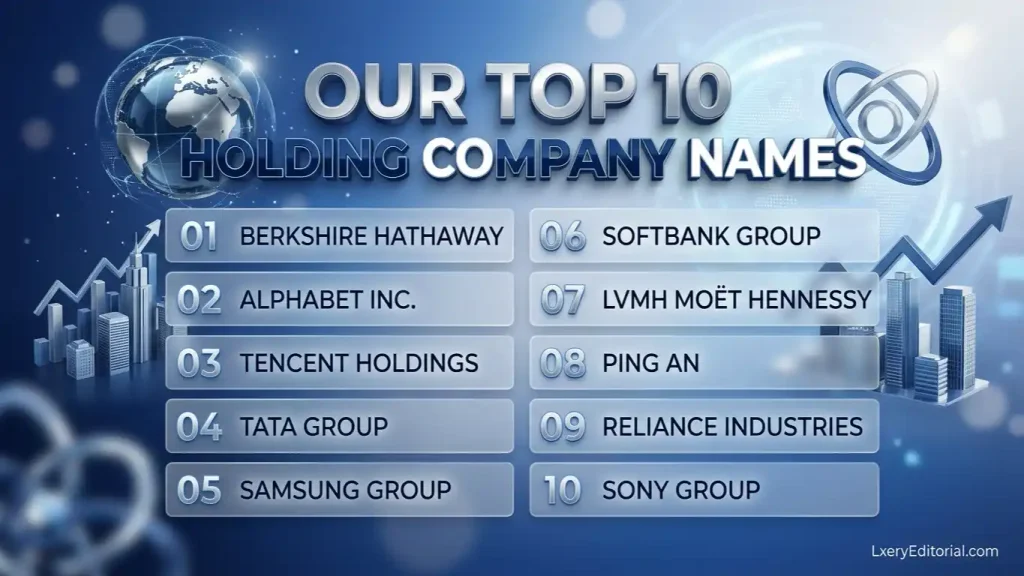
These ten selections stand out for their professional sound, flexibility, and branding potential. They are drawn from the six categories below; the shortlist does not add extra names to the 60-name collection.
| Name idea | Why it stands out | Potential fit |
| Sterling Asset Trust | Traditional and dependable in tone | Investment and asset portfolios |
| Nexus Innovation Group | Suggests connection and new ideas | Technology and diversified ventures |
| Aurelia Wealth Group | Elegant, with a golden association | Family wealth and premium businesses |
| Halcyon Alpha Corp | Contemporary yet understated | Diversified holdings |
| Hawthorne Family Holdings | Personal and established in tone | Family-owned businesses |
| Landmark Property Holdings | Clear and easy to understand | Real estate portfolios |
| Sovereign Capital Group | Authoritative and formal | Multi-industry investments |
| Quantum Asset Partners | Modern and analytical | Technology-related investments |
| Crestwood Family Capital | Traditional and long-term in tone | Family investment structures |
| Ironwood Real Assets | Suggests strength and durability | Property and tangible assets |
Our favorite overall: Sterling Asset Trust offers a traditional, professional sound. If you prefer a more modern identity, Nexus Innovation Group is worth considering. For a family-owned business, Hawthorne Family Holdings communicates its purpose more clearly.
These are editorial preferences, not endorsements or findings that the names are available.
Classic and Traditional Holding Company Names
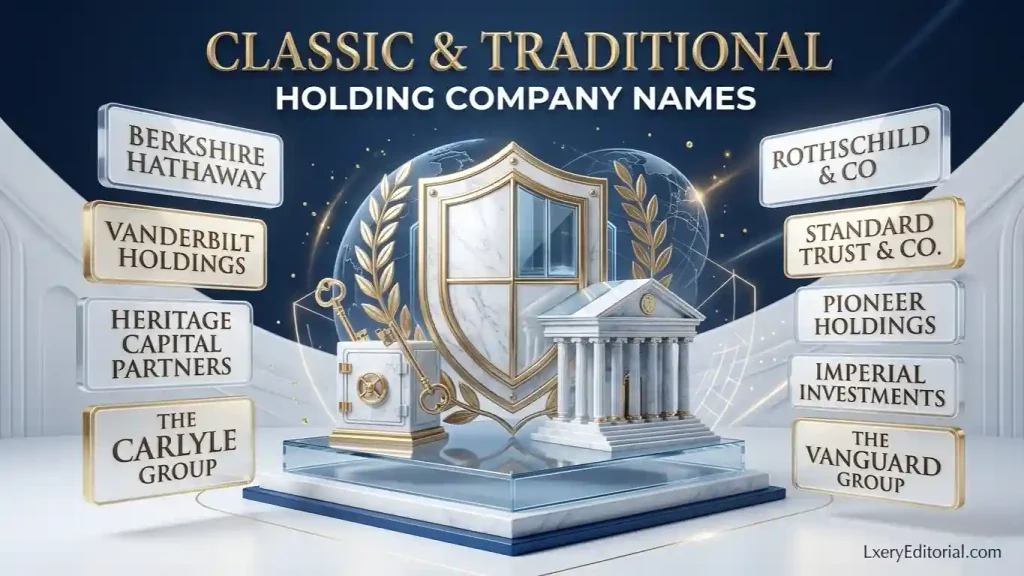
Traditional names often use familiar business language to communicate continuity, structure, and professionalism. They may suit owners who prefer an established corporate identity over a trend-driven brand.
- Sovereign Capital Group — An authoritative name for a diversified business or investment portfolio.
- Sterling Asset Trust — A traditional-sounding option for an asset-focused business.
- Pioneer Holdings Corp — Suggests initiative and a willingness to explore new opportunities.
- Commonwealth Ventures — Emphasizes shared interests and a broad range of business activities.
- Meridian Financial Trust — Uses the idea of a guiding line or reference point to create a formal identity.
- Foundation Core Corp — Suggests a central structure supporting several businesses.
- Heritage Asset Partners — Suitable for a company built around long-term ownership and continuity.
- Imperial Holding Group — A grand, formal option for a diversified parent company.
- Apex Global Trust — Combines a sense of high achievement with an international outlook.
- Forefront Enterprise Ltd — Suggests initiative and forward movement across business activities.
Best for: Owners who want a conventional corporate tone. Before using terms such as “Trust” or “Ltd,” verify whether they are appropriate under the applicable naming rules and whether the wording could imply a regulated activity or legal structure.
Modern and Tech-Forward Holding Company Names

Modern holding company names can suit parent businesses that own software firms, digital brands, e-commerce ventures, or technology investments. The strongest options feel current without depending entirely on temporary technology buzzwords.
- Nexus Innovation Group — Suggests a central connection between businesses, ideas, and opportunities.
- Quantum Asset Partners — A contemporary name for a portfolio with a technology or analytical focus.
- Voxel Holding Corp — Inspired by a three-dimensional unit used in digital graphics; potentially suitable for digital media ventures.
- Synapse Enterprise Ltd — Evokes connections and information flow.
- Vertex Digital Holdings — Suggests a focal point for digital businesses.
- Horizon Matrix Corp — Combines a broad outlook with a structured, systems-oriented identity.
- Kinetic Capital Group — Suggests activity, movement, and business development.
- Stellar Code Holdings — Connects a broad, aspirational image with software and digital work.
- Catalyst Core Partners — Suggests a central role in helping businesses develop.
- NovaSphere Ventures — A contemporary, imaginative option for emerging businesses.
Best for: A parent company focused on digital products, technology, or innovation. If the portfolio may later include unrelated industries, consider whether a tech-oriented name will still fit.
Luxury and High-End Holding Company Names

Luxury-oriented names often draw on precious materials, heritage, elegance, and elevated imagery. They can suit businesses associated with premium property, hospitality, design, or high-end consumer brands.
- Prestige Asset Alliance — A formal name for a group of premium businesses or assets.
- Opal Crest Holdings — Combines gemstone imagery with a sense of distinction.
- Regency Capital Group — Evokes traditional elegance and a structured corporate identity.
- Velvet Crown Trust — A decorative, high-end-sounding option for a premium brand portfolio.
- Elysian Wealth Partners — Draws on Elysium, the place of ideal happiness in classical mythology.
- Obsidian Core Holdings — Uses the dark, glassy appearance of volcanic rock to suggest a sleek identity.
- Grandeur Enterprise Ltd — Emphasizes scale and an elevated brand image.
- Amberlight Holdings — Suggests warmth, light, and a refined aesthetic.
- Aurelia Wealth Group — Uses a name associated with gold to create an elegant impression.
- Platinum Veil Trust — Combines precious-metal imagery with a discreet, premium tone.
Best for: A portfolio involving premium real estate, hospitality, design, or luxury consumer brands. Avoid names that imply regulated financial services or guaranteed protection unless the business is legally entitled to make those representations.
Neutral and Discreet Corporate Names

A neutral parent-company name can be useful when the operating businesses have different identities. It allows each subsidiary to build its own public brand while the parent provides an overarching ownership structure.
- Halcyon Alpha Corp — Combines a calm, composed association with a modern business term.
- Sector Five Group — A concise, structured name that does not identify one particular industry.
- Northline Partners — Suggests direction and a straightforward corporate identity.
- Sigma Core Holdings — Uses a Greek letter often associated with mathematics and statistics.
- Equinox Capital Ltd — Evokes balance and a point in the seasonal cycle.
- Bastion Holding Corp — A bastion is a defensive stronghold, making this a strong-sounding option.
- Axis Mundi Partners — Draws on the Latin expression for the world’s central axis; distinctive but less immediately accessible.
- Blue Ridge Asset Co — A restrained, nature-inspired name with a regional feel.
- Omnihold Assets — A compact invented-style name that suggests a broad asset portfolio.
- Quorum Trust — Uses a governance term referring to the minimum number of members required to conduct certain business.
Best for: A diversified parent company that wants a low-profile identity. Before choosing a geographic reference such as “Blue Ridge,” consider whether it could mislead customers about the company’s location or service area.
Family and Legacy Holding Company Names
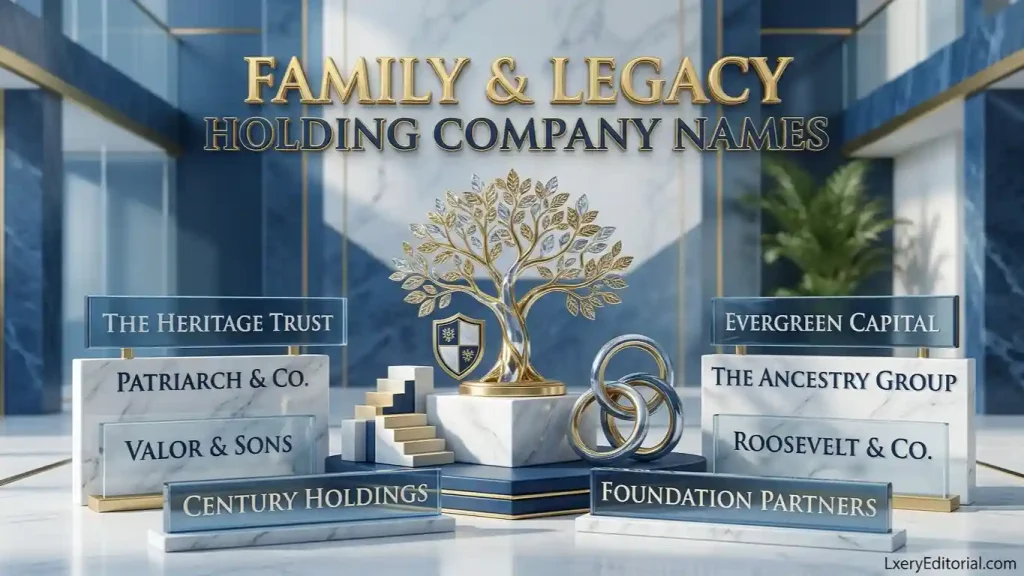
Family holding companies often focus on continuity, shared ownership, and the transfer of assets between generations. A family name can be meaningful, but a broader name may offer more flexibility if ownership or the portfolio changes over time.
- Hawthorne Family Holdings — A traditional-sounding name for a family-owned portfolio.
- Heirloom Legacy Group — Emphasizes the idea of assets passed from one generation to another.
- Crestwood Family Capital — Combines a traditional place-name style with a family investment focus.
- Ashford Partners — A concise, surname-style option for a privately owned business group.
- Compass Family Office — Suggests guidance and coordination for a family’s financial affairs.
- Oakridge Holdings — Uses the oak as a familiar symbol of strength and longevity.
- Palladium Family Group — Draws on the name of a precious metal for a formal, premium tone.
- Whitmore Capital — A traditional surname-style name for a family investment company.
- Evergreen Legacy — Suggests continuity and a long-term outlook.
- Fairhaven Group — Evokes a stable, welcoming place and suits a family-owned group of businesses.
Best for: Family-owned businesses, succession planning structures, and diversified private holdings. A name alone does not establish a family office, trust, or other legal arrangement; the actual structure depends on the documents and laws involved.
Real Estate and Asset Holding Company Names

Property-focused holding companies often benefit from names that evoke land, stability, location, or long-term ownership. These names may also work for portfolios that include commercial buildings, residential property, land, or other tangible assets.
- Landmark Property Holdings — A clear option for a company that owns or manages a property portfolio.
- Crestview Realty Group — Suggests an elevated outlook and a real estate focus.
- Ironwood Real Assets — Combines durable imagery with a broad tangible-asset identity.
- Terra Land Holdings — Uses terra, a Latin word associated with earth or land.
- Keystone Property Group — Refers to the central stone in an arch and suggests a supporting role.
- Pinnacle Realty Holdings — Evokes an uppermost point and a premium property identity.
- Summit Property Capital — Combines mountain imagery with a property investment focus.
- Willow Estates Group — Uses natural imagery for a residential or land-focused portfolio.
- Atlas Real Estate Group — Draws on the figure of Atlas in Greek mythology, traditionally associated with bearing the heavens.
- Harborview Property Holdings — Suggests shelter and a view, making it suitable for a property-oriented brand.
Best for: Property ownership, real estate investment, land holding, and development businesses. Use terms such as “Realty” or “Property” when they reflect the intended business, and confirm local naming rules before registering.
Famous Holding Companies and What Their Names Teach Us
Established companies show that a successful corporate name does not always need to explain every part of the business. Some names come from earlier businesses, some from a family, and others from deliberate wordplay. Their histories offer lessons, but their names should not be copied as ready-made suggestions.
1. Berkshire Hathaway
The name traces back to the merger of Berkshire Fine Spinning Associates and Hathaway Manufacturing in 1955. Warren Buffett gained control of the company in 1965, and its business later moved far beyond its textile origins. <Cite refs={[“turn470480search11″,”turn470480search7”]}/>
Naming lesson: A name can outlast the industry in which a company began. A flexible name may remain useful even as the business changes substantially.
2. Alphabet Inc.
Larry Page announced Alphabet in 2015 as a new corporate structure for Google and related businesses. He explained that the word refers to the letters representing language, while “alpha-bet” also plays on the idea of investment returns above a benchmark. <Cite refs={[“turn610807search1″,”turn610807search8”]}/>
Naming lesson: A name with more than one relevant association can be memorable, provided the word is easy to understand and use.
3. SoftBank Group
SoftBank began in 1981 as a distributor of computer software. The company explains that “SoftBank” literally means “a bank of software,” reflecting its original software-related role and broader ambition to support the information society. <Cite refs={[“turn610807search0″,”turn610807search9”]}/>
Naming lesson: A name can reflect the original business and still accommodate significant expansion.
4. Tata Sons
Tata Sons is closely associated with the Tata business group and its founding family name.
Naming lesson: A family surname can provide continuity and a strong identity. It can also tie the company’s public reputation closely to the family, so it should be chosen thoughtfully.
5. BlackRock
BlackRock traces its founding to 1988, when a group of colleagues established an investment management business. The firm was initially named Blackstone Financial Management and changed its name to BlackRock in 1992. <Cite refs={[“turn470480search1″,”turn470480search6”]}/>
Naming lesson: A short, distinctive word can support a professional identity across a growing portfolio. A similar-sounding name should not be copied, particularly in a related industry.
6. Vanguard Group
Vanguard is a long-established investment management company founded by John C. Bogle in 1975. Its official history emphasizes its investor-focused ownership structure and long-term approach. <Cite refs={[“turn610807search2″,”turn610807search11”]}/>
Naming lesson: A memorable name works best when it is supported by a consistent business purpose. Do not assume that an established company’s name is available for another business to use.
7. Prosus
Prosus became the listed group for Naspers’ international internet assets in 2019. Its portfolio includes consumer internet businesses and technology investments. <Cite refs={[“turn470480search10”]}/>
Naming lesson: A distinctive name can give an international portfolio a separate identity. If you choose an invented or uncommon word, explain its intended association rather than inventing a historical origin.
8. Exor
Exor became the name of the surviving company after the merger of IFI and IFIL took effect in March 2009. The company explained that the name supported its international development plans and a clearer identity for the Agnelli family’s investment activities. <Cite refs={[“turn470480search5″,”turn470480search8”]}/>
Naming lesson: A name can help unify several investment activities under one parent identity without describing every subsidiary.
9. Reliance Industries
Reliance Industries uses a familiar English word as its corporate name. The word evokes trust and dependence, although the name alone does not establish the company’s performance or reliability.
Naming lesson: An accessible word can create a straightforward brand identity. Its value depends on how distinctively and consistently the company uses it.
The key takeaway from these examples is simple: choose a name that fits your intended structure, remains flexible as the business develops, and can be used without creating confusion with an existing brand.
Names to Think Twice About
Some names sound appealing but may create avoidable problems. Before committing, consider these six common traps.
1. Names that closely resemble established brands
A name that resembles an existing company in the same or a related industry can create confusion and possible trademark disputes. Check exact matches and similar spellings, pronunciations, and meanings.
2. Fictional names with existing associations
Names used by well-known films, games, books, or fictional corporations may have existing trademark or commercial associations. Do not assume a fictional name is free to use simply because it is not a real company.
3. Generic combinations
Words such as “Global,” “Premier,” “Capital,” and “Holdings” are common. A generic combination may be difficult for customers to distinguish from similar businesses and may offer limited branding flexibility.
4. Unsupported promises
Avoid names that imply guaranteed returns, government approval, insurance, or legal protection when those claims do not accurately describe the business. A name should not mislead customers or business partners.
5. Unclear invented meanings
Invented words can make strong brand names, but their stories should be honest. If you create a word for its sound or visual appearance, explain that it is a coined name rather than assigning it a false dictionary or historical meaning.
6. Names that restrict future growth
A parent company named after one product or industry may become awkward if it later owns unrelated businesses. Consider whether the name will still fit after an acquisition, merger, or diversification.
How to Check Holding Company Name Availability
Use this checklist before filing paperwork, buying a domain, or printing business materials. It is a screening process, not a guarantee that a name is legally available.
Step 1: Search the business registry
Check the official business-name registry for the state or country where you intend to form the company. Search for exact matches and names that could be considered confusingly similar under local rules.
For a US company, begin with the relevant state’s Secretary of State or equivalent business filing authority.
Step 2: Search the trademark database
For the United States, use the official USPTO Trademark Search system. The former TESS system was retired in November 2023 and replaced by the current search system. <Cite refs={[“turn610807search4″,”turn610807search10”]}/>
Search similar wording and consider the goods or services associated with the marks. If you plan to operate internationally, check the relevant trademark registers in those markets as well.
Step 3: Check domain names
Search for the exact .com domain and any country-specific domains you may need. Also consider common misspellings that customers could enter.
A domain being available does not mean that you have trademark rights to the name. Likewise, an unavailable domain does not necessarily mean that you cannot legally register the company.
Step 4: Check social media and business directories
Look for the name on the platforms where your business is likely to have a presence. Search business directories and relevant industry listings for similar names that could confuse customers, suppliers, or partners.
Step 5: Review the legal structure and suffix
Confirm that the proposed name complies with local formation rules and accurately uses any required legal ending. Some words are restricted or may require special authorization in particular jurisdictions.
Step 6: Get professional advice before committing
If the name is central to your long-term brand, consider asking a qualified trademark lawyer to assess potential conflicts before you invest in the name. This is particularly useful for international businesses, acquisitions, and companies operating in regulated industries.
Important: This article provides general naming information, not legal, tax, or investment advice. Corporate registration and trademark clearance are separate processes, and neither guarantees that every use of a name will be lawful.
Frequently Asked Questions
What exactly is a holding company?
A holding company is a business that owns shares or controlling interests in other companies. Depending on its structure, it may also hold property, intellectual property, or other investments directly. Its responsibilities depend on the ownership arrangement and applicable law.
Does a holding company name have to include the words “holding company”?
No. Those words are not universally required. The acceptable name and legal suffix depend on the entity type and the jurisdiction where the company is formed.
What makes a good holding company name?
A good name is distinctive, easy to pronounce, appropriate for the intended business structure, and flexible enough to accommodate future growth. It should also be screened for existing business names and potential trademark conflicts.
Should a holding company have the same name as its subsidiaries?
Not necessarily. A separate parent-company name can help distinguish the ownership structure from the operating brands. It can also make it easier to explain which company owns an asset or conducts a particular business activity.
Can I use a holding company name that is already registered in another state?
Do not assume that you can. The answer depends on applicable corporate naming rules, trademark rights, the relevant industries, and where the businesses operate. A name accepted by one filing authority is not automatically cleared for every use elsewhere.
Do I need a trademark for my holding company name?
Not every business must register a trademark, but a name may have legal significance even without a federal registration. Registration can provide additional rights, subject to the applicable law and circumstances. Search first and obtain legal advice if the brand is important to your business.
How many holding company names should I shortlist?
Start with three to five names that match your business goals. Compare their clarity, flexibility, professional tone, and potential for confusion, then check each candidate’s availability before making a final choice.
Can a holding company name protect my personal assets?
No. A company name alone does not create asset protection or guarantee anonymity. Any protection depends on the legal structure, applicable law, how the business is operated, and other relevant circumstances. Consult a qualified professional about your specific situation.
What Makes This List Different?
A useful holding company name list should do more than combine impressive-sounding words. It should help readers compare naming styles, understand what a name communicates, and identify the checks required before committing to one.
This guide provides 60 suggestions across six distinct categories, a separate top-10 shortlist, examples of established corporate naming choices, and a practical availability checklist. It also distinguishes creative naming ideas from legal conclusions about whether a name can be used.
If you are exploring other naming styles, you can also browse our guides to nature-inspired business names and clothing brand name ideas for more inspiration.
Final Thoughts
Choosing a holding company name is an early decision that can shape how your business is presented for years to come. A strong name should be easy to remember, suitable for your ownership structure, and flexible enough to accommodate future acquisitions or new business interests.
Start with the 60 suggestions in this guide, select three to five favorites, and test each against your long-term goals. Then check the relevant business registry, trademark database, domain availability, and existing market use before committing.
The best choice is not necessarily the most luxurious or complicated name. It is the one that fits your business, communicates the right impression, and survives careful availability checks.

Mustansar Abbas is a writer and author of the article “Ghazians.com” He is passionate about creating meaningful and engaging content that connects with readers through clear ideas and thoughtful expression.